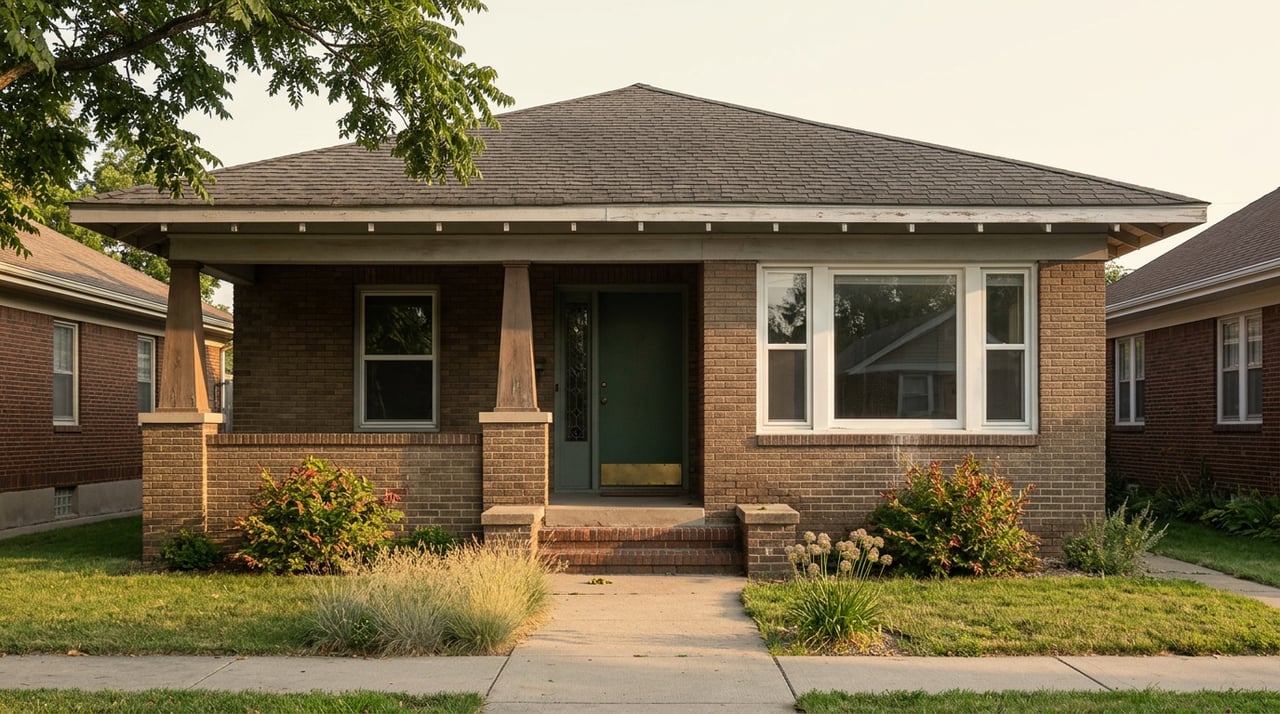
Gary Property Tax Closing Questions for 2026 Homebuyers
August 20, 2026
August 20, 2026
If you're closing on a Gary home this year, the tax credit on your settlement statement won't match what a quick look at last year's bill would suggest. That's true every year in Indiana, because the state collects property taxes a year behind. But 2026 adds a second layer most closings never see: Indiana is six years into a property tax overhaul that changes the deduction and credit numbers every single year through 2031, and even the professionals who write about this for a living can't agree on which bill shows the new numbers first. That disagreement isn't a footnote. It's the exact thing your title company has to resolve before they can tell you what you owe or what you're owed.
Indiana bills property taxes a year behind. The two statewide due dates, May 10 and November 10, always cover the prior year's assessed value, not the year you're currently living in the house. That means most Gary sellers haven't yet been billed for the months they owned the home this year, so instead of getting a refund at closing, they hand the buyer a credit. The buyer takes that credit and uses it, along with their own money, to pay the full bill when it eventually arrives.
That part is consistent and well documented. What isn't consistent is the size of the number, because the deductions and credits that feed into that calculation are moving targets right now.
Indiana passed Senate Bill 1 in April 2025, and Senate leaders framed it as $1.3 billion in relief for homeowners over three years, with a new credit worth 10 percent of the bill, capped at $300, layered on top of a shrinking standard deduction and a growing supplemental one. The trade is straightforward on paper: a flat-dollar deduction phases out while a percentage-based deduction and a new credit phase in.
Here's roughly how that trajectory looks, based on the schedule described in multiple 2026 professional summaries:
| Tax bill labeled | Standard deduction | Supplemental deduction | New homestead credit |
|---|---|---|---|
| Payable 2025 | $48,000 | 37.5% | none |
| Payable 2026 | $40,000 | 40% | 10%, up to $300 |
| Payable 2027 | $30,000 | 46% | 10%, up to $300 |
| Payable 2030 or 2031 (sources differ on the exact year) | $0 | 66.7% | 10%, up to $300 |
That's the version described in a March 2026 homeowner guide and echoed in a Lake County-focused legal guide published the following month. But a Northwest Indiana mortgage lender's guide, published that same spring, places the same relief a full year later, arguing the 2026 bill "was set before this law applied" and telling homeowners in Lake, Porter, LaPorte, Jasper, and Newton counties not to expect the new numbers until bills arrive in 2027.
This isn't really a policy dispute. It's a labeling problem baked into the arrears system itself. Because every Indiana bill is already a year behind, writers describing the reform sometimes mean the assessment year and sometimes mean the year the bill shows up in your mailbox, and those two things are never the same twelve months. If a Northwest Indiana lender and other 2026 guides can land on different years for the same relief, a buyer or seller in Gary has no reasonable way to guess which one applies to the specific bill sitting in front of them at closing.
Indiana's own Lieutenant Governor, weighing in on the bill's rollout, put it bluntly: "nobody understands it."
That's not an exaggeration for effect. It's a description of a system where credentialed professional sources, writing in the same year, disagree about which bill shows the new numbers first.
Lake County's median assessed home value sits at $135,400, with an effective tax rate of 1.37 percent and a median annual bill around $1,852. Use that median bill as a rough stand-in and the arrears math is simple: if a seller closes on June 15, they've owned the home for 165 of the year's 365 days, so they'd credit the buyer about $837 on a bill that size. The buyer then owes the rest, plus their own share going forward.
That part of the math holds regardless of what SB1 is doing. Where it gets murky is the size of the bill itself. Whether that $1,852 figure already reflects the new 10 percent credit, or whether it's still calculated the old way and the credit shows up a year later, changes the number your title company should actually be using by something in the range of $150 to $300, depending on which bill and which year's rules apply. On a house at or below the county median, that's not a rounding error. It's real money moving in one direction or the other, and it depends entirely on a labeling question that professional publications answered differently in the same year.
The practical fix is simple: don't rely on last year's bill as a stand-in for this year's math. Ask your title company or closing agent directly which specific bill, and which specific set of deduction and credit figures, they're using to calculate your proration. That single question resolves an ambiguity that generic closing-cost guides can't.
None of the SB1 relief applies automatically to a home that isn't already flagged as a homestead in the county's system. If you're buying in Gary and this will be your primary residence, you need to file the homestead deduction with the Lake County Auditor. The general filing deadline is December 31 of the year you take ownership, so the deduction shows up on the following year's bill. Miss that window and you're paying a materially higher bill for a full cycle before the deduction and its associated credit catch up.
This matters more than usual in 2026 because the credit itself is new. A buyer who assumes their deduction "just happens" because the previous owner had one filed is assuming wrong. Ownership changes reset the filing requirement, and the auditor has no way to know your intentions unless you tell them.
Some Gary buyers, particularly small investors, are looking at Lake County's Commissioner's Sale rather than a standard MLS purchase. This year's sale lists more than 6,300 delinquent-tax parcels across the county, and Gary makes up a meaningful share of that inventory. One local investor-focused platform built by Armond Boulware, a licensed broker and general contractor with more than 200 Lake County tax sale acquisitions of his own, has built tools specifically to filter that inventory by property type.
That track runs on a completely different clock than a normal closing. A tax sale certificate buyer has to notify interested parties within a set window after the sale, typically 90 days after a Commissioner's Sale, and the prior owner still has a redemption period to reclaim the property. If redemption doesn't happen, the buyer has to petition the court for a tax deed within three months of the redemption period ending, or the lien terminates. None of the arrears-and-SB1 proration mechanics above apply the same way to a tax deed purchase, because you're not negotiating a credit with a willing seller. You're working through a court process with its own deadlines.
If you're weighing a lot or a small multifamily building through the City of Gary's own Redevelopment Commission instead, that process is different again. The Commission handles land disposition through a request-for-proposal process, followed by a 30-day quiet period if a bid is denied, before any land closing and title transfer happens.
One more date matters here, even though it's already behind us this cycle. Lake County's appeal deadline for the current assessment was June 15, 2026, or 45 days after your Form 11 notice, whichever came later. If you're selling now, that window closed months ago, so an over-assessment argument won't change this year's bill. If you're buying, the same 45-day-after-Form-11 rule will apply to you the next time a new assessment notice arrives, and it's worth marking your calendar the moment that notice shows up rather than waiting for a reminder.
Does my homestead deduction carry over from the previous owner? No. Ownership changes require a new filing with the Lake County Auditor, generally by December 31 of the year you take title, for the deduction to appear on the following year's bill.
Will I know my exact seller credit before closing day? Your title company will give you a number based on the most recent billed amount, but ask them explicitly which tax year's rules that bill reflects. Given how differently professional sources are labeling 2026 versus 2027 bills right now, that one question is worth more than any generic estimate.
Does the senior or veteran credit still work the same way? Not quite. As of bills payable in 2026, Lake County's Over-65 benefit shifted from a deduction to a $150 flat credit for qualifying income levels, with a separate Over-65 Circuit Breaker capping annual increases at 2 percent for those with stricter income limits. You can claim one or the other, not both, and applications are due to the Auditor by January 15 each year.
Gary's tax mechanics are unusually unsettled this year, and that's exactly the kind of detail worth getting right before you sign anything. If you're weighing a purchase, a sale, or a tax sale parcel in Gary or anywhere across Chicagoland and Northwest Indiana, Anthony Kirkland can walk through what your specific closing date actually means before you commit to a number. Let's Connect.



Anthony Kirkland offers a steady, market-informed approach to real estate defined by consistency, clear communication, and strong local insight. Serving Chicago, Chicagoland, and Gary, Indiana, he provides focused guidance shaped by each market’s distinct conditions. His approach is strategic and responsive, centered on informed decision-making and strong results.

Anthony Kirkland
10916 S CICERO AVE OAK LAWN, IL 60453