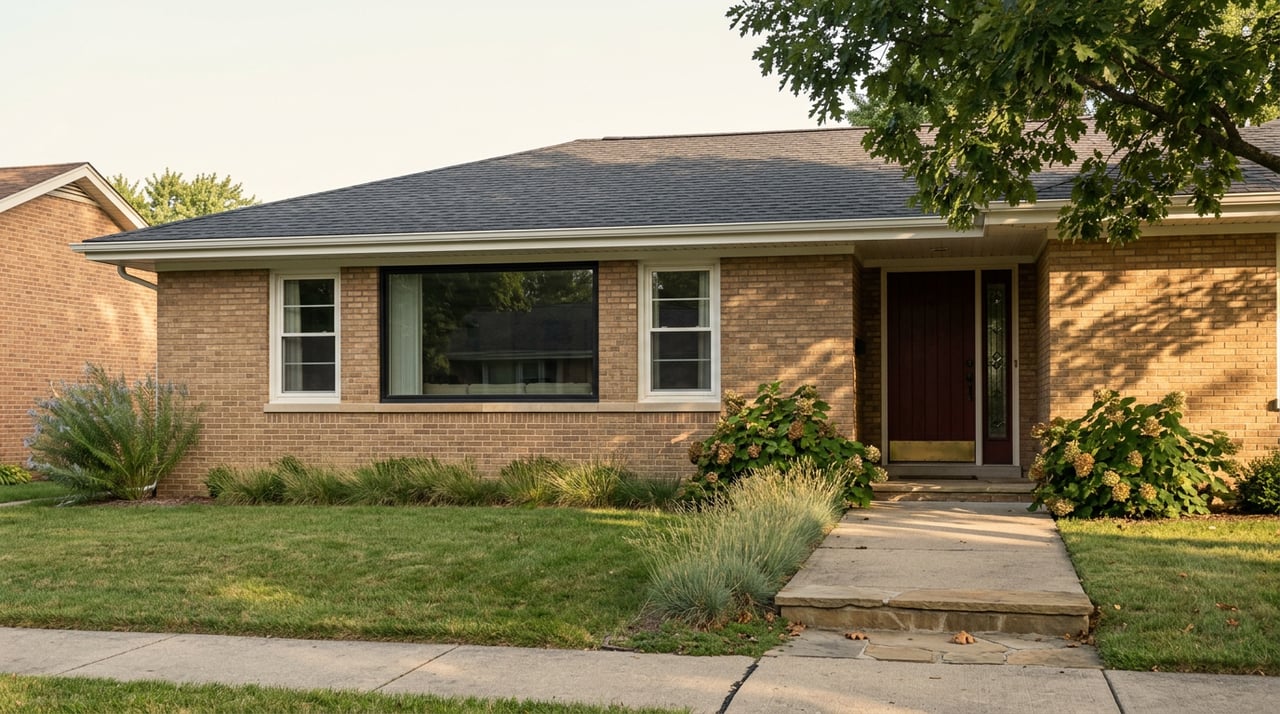
Homewood's 2026 Housing Market: Two Price Stacks to Watch
July 23, 2026
July 23, 2026
A buyer opens a portal, types in Homewood, and sees a single number. Movoto shows a $244,450 median sold price for April 2026. Zillow's index sits at $228,992. Redfin logs $226K for March. The numbers look close enough to average, so the buyer averages them and moves on to the next tab.
That average is the trap. Homewood in 2026 is running two nearly separate housing markets under one ZIP code, and a summer of infrastructure work plus a 146-unit downtown rental pipeline is quietly repricing one of them before the portals catch it.
The clearest read on the split comes from active inventory rather than sold comps. On June 5, 2026, one brokerage feed showed 90 single-family homes for sale with an average list price of $284,509, alongside 36 condos and townhomes with an average list of $131,019. The SFH range ran from $149,900 to $749,900. The attached range topped out at $237,000.
| Segment | Active listings (June 2026) | Avg list price | Range |
|---|---|---|---|
| Single-family | 90 | ~$284,500 | $149,900 – $749,900 |
| Condo / townhome | 36 | ~$131,000 | $70,000 – $237,000 |
| Downtown Homewood (all types, TTM) | ~small supply | median sale ~$170,000 | $140K – $370K |
A $259K median list price across the ZIP is a real number and a misleading one. It sits inside a gap where almost nothing is actually listed. A buyer with $250,000 is not shopping the same market as a buyer with $150,000 for a two-bedroom near the Metra platform.
The single-family side is soft. Bowers Realty Group's read of MLS activity through January 2026 put 247 active SFH listings against 13 January closings, an absorption rate of roughly 19 months of supply. Redfin's March 2026 snapshot showed 18 sales at 79 days on market, with the price per square foot up 8.1 percent year over year but the headline median down 9.44 percent. Those two numbers move in opposite directions only when smaller, older, or more discounted homes are dragging the median while the survivors hold their per-foot value. That is a mix-shift story, not a value-collapse story, and it matters for how a seller should price.
The condo and downtown side behaves differently. Sales in the immediate downtown core close in roughly three weeks when they do occur, but supply is thin. The Realtor feed with the June 2026 count shows condos moving at a per-square-foot pace that rose 9.38 percent week over week against 1.93 percent for detached homes. That is a small sample with real noise in it, but the direction is consistent with what the Hartford Building is telling anyone paying attention: Optiv Properties reports no available units and rental demand described as strong from empty-nesters downsizing and young adults leaving their parents' homes, at asking rents of roughly $2,200 to $2,500 for a two-bedroom.
The friction most buyers miss is the one between those two stacks. A move-up buyer selling a $270K ranch to trade into a $600K house in Ravisloe is fighting the SFH softness on the way out. A downsizer selling that same ranch to move into a $180K downtown condo is competing with a shrinking pool for the unit they want to buy.
On February 10, 2026, the Homewood Village Board selected Holladay Properties as the preferred developer for two transit-oriented sites: the Village Hall parking lot at 2024 Chestnut Road and the Matrix Building at 2066 Ridge Road. The March revisions kept the project at 146 units across the two sites with 8,000 square feet of commercial space, added ten public parking spaces, and eliminated a $4,400 two-bedroom unit after resident pushback on rent. Groundbreaking is targeted for 2026 and delivery for the fourth quarter of 2027. The Village describes it as the largest TOD investment in Homewood's 133-year history.
Two things follow for a buyer or investor reading current comps.
First, the rental comps that back into a downtown condo's investment case are about to get harder, not softer. If Holladay lands rents in the same band the Hartford Building is holding, the market absorbs another 146 units aimed at the same empty-nester and young-professional pool that is currently keeping downtown condo turnover tight. A landlord underwriting a two-bedroom at $1,700 today should stress-test against $2,000 in supply next year.
Second, the redevelopment agreement, TIF terms, and Planned Development review are still ahead of Holladay. Anyone buying a nearby property on the assumption that Q4 2027 delivery is fixed should read the Village Board minutes rather than the press release. The Southland Development Authority's rival proposal made it clear how much can move between stages: it revised from 107 units to 123 units, shifted TIF asks from 100 percent to 85 percent, and pushed completion to Q4 2027 all in one meeting cycle.
The other price signal working through the 2026 comp file is not a listing at all. The Illinois Department of Transportation began a major infrastructure project at the Dixie Highway viaduct in March 2026, with construction expected to run through roughly October. The viaduct is the pedestrian and vehicular seam between the residential blocks north of downtown and the Central Business District that anchors the whole Homewood pitch: Homewood Brewing Company, Gaia's Market & Refillery, Aurelio's Pizza, 69 Prime Steakhouse, La Banque Hotel, Martin Avenue Square, and the Homewood Science Center. Add the $14.5 million Metra station renovation to the same summer and any showing of a downtown-adjacent condo carries a temporary walkability discount that the portal photo does not show.
The interpretive move for a buyer: a spring 2026 comp near Dixie or Ridge that sat on the market longer than its counterparts probably has a construction reason rather than a condition reason baked into its final price. A seller listing into that same window should either price for the friction or wait for the ribbon-cutting. For an investor, the summer creates a specific window where a well-located condo can trade below its post-2027 replacement cost, and that window is measurable in months rather than years.
Reading through the June 2026 active file and the Downtown Homewood transaction band of $140K to $370K over the trailing year, the tiers look like this:
The single-family softness is real, but it is a mix and marketing-time problem more than a value problem for a well-prepared listing. The downtown and condo side is tighter than any headline suggests, and the 2027 supply pipeline plus the summer construction window is the part of the market that is not yet in the portals. A seller pricing off last spring's median without adjusting for where their unit sits in the two stacks will leave money on either side of the trade.
Reading Homewood well in 2026 means treating the ZIP as two files, not one, and reading the Village Board minutes as part of the comp set. If you would like a segment-specific read on your block, price band, or investment case, Anthony Kirkland is happy to walk the numbers. Let's Connect.
Anthony Kirkland offers a steady, market-informed approach to real estate defined by consistency, clear communication, and strong local insight. Serving Chicago, Chicagoland, and Gary, Indiana, he provides focused guidance shaped by each market’s distinct conditions. His approach is strategic and responsive, centered on informed decision-making and strong results.

Anthony Kirkland
10916 S CICERO AVE OAK LAWN, IL 60453