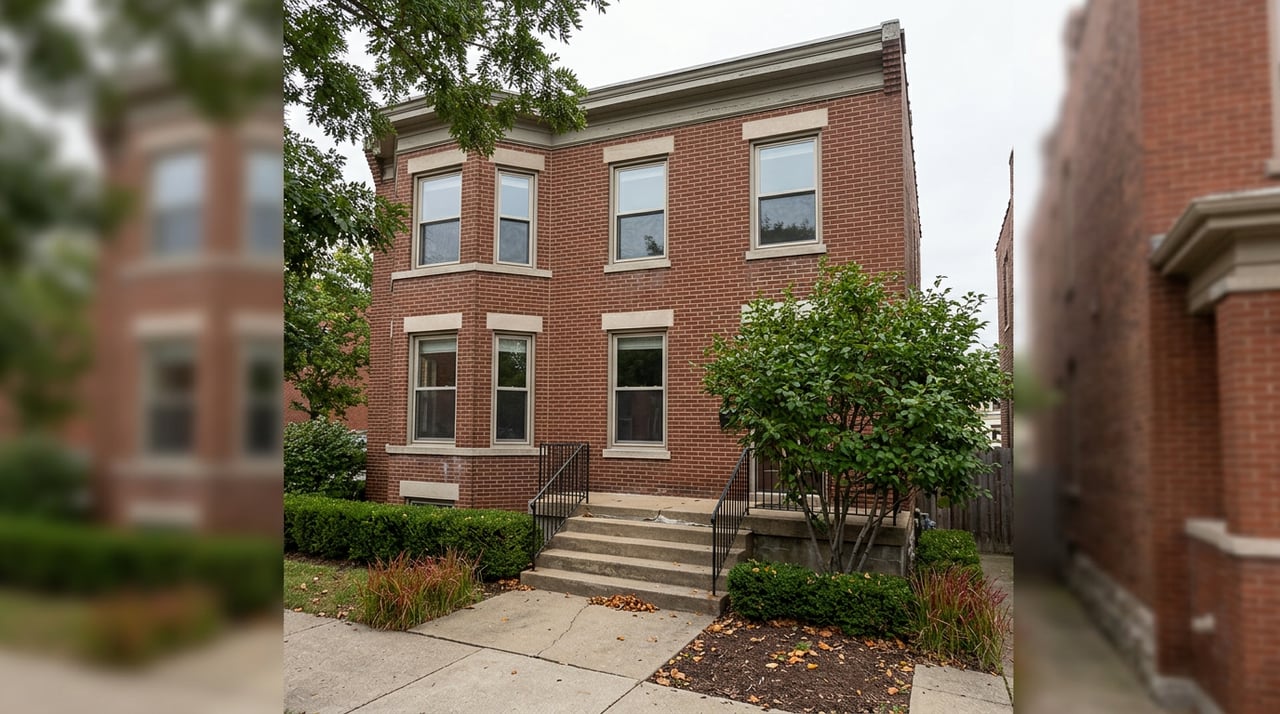
South Shore Real Estate in 2026: A Falling Median and a Rezoning Push, Happening at the Same Time
September 24, 2026
September 24, 2026
As the Chicago Sun-Times reported, Lakiesha Williams found out her lease wasn't being renewed on a December 24 phone call. She'd run Mama Africa's Marketplace at 2100 E. 71st Street for five years, a consignment shop and community space that had hosted roughly 300 organizations and ran a youth employment program out of a 4,000-square-foot storefront. The building's property tax bill told the rest of the story. In 2022 it was $16,463. By 2025 it had climbed to $58,592, a 255 percent jump that pushed the landlord to sell rather than absorb the increase, and pushed Williams out with it.
That story gets told as a gentrification narrative, and with the Obama Presidential Center two miles away and opening this past June, it's an easy one to reach for. But the more useful story, the one that actually explains what's happening to property values along 71st Street right now, came out of a public meeting on September 8 that had nothing to do with the Center at all. It was about zoning. And the answer a city planner gave there cuts directly against the assumption behind the Mama Africa's story.
If you've pulled comps on South Shore recently, you've seen a market that looks soft. Over the three months ending in May 2026, the median sale price came in at $144,000, down 15.3 percent from the same period the year before. Homes sat on the market for 101 days on average, nearly double the 56 days from a year earlier. Seventy-seven homes sold in May, down from 89 the prior May. Multi-family listings span a wide range, from $150,000 up to $2.895 million, with the median multi-family asking price around $342,000 as of that same window.
Read those numbers cold and you'd assume South Shore is cooling. Read them next to what the city is doing on 71st Street and a different picture forms: the median isn't measuring demand for the neighborhood as it exists today. It's measuring a housing stock that's still operating under zoning rules the city itself is in the middle of rewriting.
The account of the meeting and proposals below follows Block Club Chicago's report.
Alderman Desmon Yancy, who represents the 5th Ward, introduced a package of rezoning ordinances in July that would touch large stretches of 71st Street between Stony Island Avenue and Yates Boulevard. His reasoning, delivered at a public meeting at Bryn Mawr Community Church on 7000 S. Jeffery Boulevard, was blunt: South Shore has almost no room to grow outward, so the only direction left is up.
The proposals had been scheduled for a zoning committee hearing at 10 a.m. on September 22 at City Hall. The stated deadline for written public comment was 8 a.m. on September 21.
At the September 8 public meeting, a city planner named Petersen made a point that's worth sitting with if you're trying to understand where South Shore values are headed.
"There's a perception where new development is a cause of property tax increases, but really, it's kind of the opposite. It's all of the vacant land, all of the tax-delinquent land, that shifts tax burdens to homeowners."
That statement inverts the logic behind the Mama Africa's Marketplace story. The building at 2100 E. 71st Street didn't see its tax bill rise because a new development arrived next door. It rose because the corridor around it, and the city's overall tax base within it, is carrying a large volume of vacant and underused parcels that pay little or nothing into the pool the rest of the tax burden gets spread across. Filling those parcels with taxpaying buildings, not leaving them empty, is the mechanism the city is betting on to eventually ease that pressure, not add to it.
Part of what's made 71st Street hard to read as an investor is that the zoning has never been consistent along its length. The proposal breaks the corridor into three functional segments:
| Stretch | Current zoning | Proposed zoning |
|---|---|---|
| Central, at 71st and Jeffery | Inconsistent, parcel-by-parcel patchwork | Larger shopping centers and storefronts, sit-down restaurants with liquor licenses, apartments above street level by default, ground-floor apartments with zoning board approval |
| West, toward Stony Island Avenue | Permits car-centric uses on vacant land, including the site of the existing U-Haul storage facility | Storefronts and ground-floor apartments by default, with a narrower list of allowed business types than the central zone |
| East, toward Yates Boulevard | Caps most new development at two stories | Same storefront and ground-floor default as the western stretch |
The point of the split isn't to make the central blocks near Jeffery denser for its own sake. It's to stop vacant lots on the western end from becoming more storage facilities and parking lots, which is what the current zoning there allows by default, while giving the eastern stretch room to grow past its current two-story ceiling.
None of this shows up in a median sale price yet, because rezoning doesn't build anything on its own. The ordinances, if approved, don't force any property owner to change an existing building, and they don't guarantee a developer shows up the following week. What they do is remove the legal ceiling that's been keeping certain kinds of projects from penciling out at all.
That matters differently depending on what you're trying to do in South Shore right now.
If you're a longtime South Shore property owner watching your tax bill climb the way Mama Africa's Marketplace did, the planner's comment cuts both ways. It suggests relief is more likely to come from filling in the vacant parcels around you than from stopping new construction near you. It also means the timeline for relief runs on the city's development pace, not on a single zoning vote.
Does the rezoning force me to change my building if it passes? No. City officials have been explicit that rezoning doesn't require existing property owners to modify anything or build anything new. It changes what's legally permitted on a lot going forward, not what's required of what's already there.
What was the written-comment deadline? The stated deadline was 8 a.m. on September 21, the day before the scheduled committee hearing.
Will my property taxes change right away if this passes? Not immediately. Zoning changes and property tax assessments run on separate tracks. The connection the planner drew is longer term: more taxpaying development on currently vacant land, over time, is the mechanism city officials are pointing to for easing the burden that's landed on existing owners.
South Shore in September 2026 is a neighborhood where the paperwork is moving faster than the comps. If you're trying to figure out what a specific block, lot, or building is actually worth against that backdrop, that's a conversation worth having before you run the numbers on your own. Anthony Kirkland works South Shore, the rest of Chicago's South Side, and Northwest Indiana as The Ace Broker with Coldwell Banker Realty. Let's connect.
This article is general information, not legal, tax or financial advice. Consult a qualified professional about your situation.
Anthony Kirkland offers a steady, market-informed approach to real estate defined by consistency, clear communication, and strong local insight. Serving Chicago, Chicagoland, and Gary, Indiana, he provides focused guidance shaped by each market’s distinct conditions. His approach is strategic and responsive, centered on informed decision-making and strong results.

Anthony Kirkland
10916 S CICERO AVE OAK LAWN, IL 60453