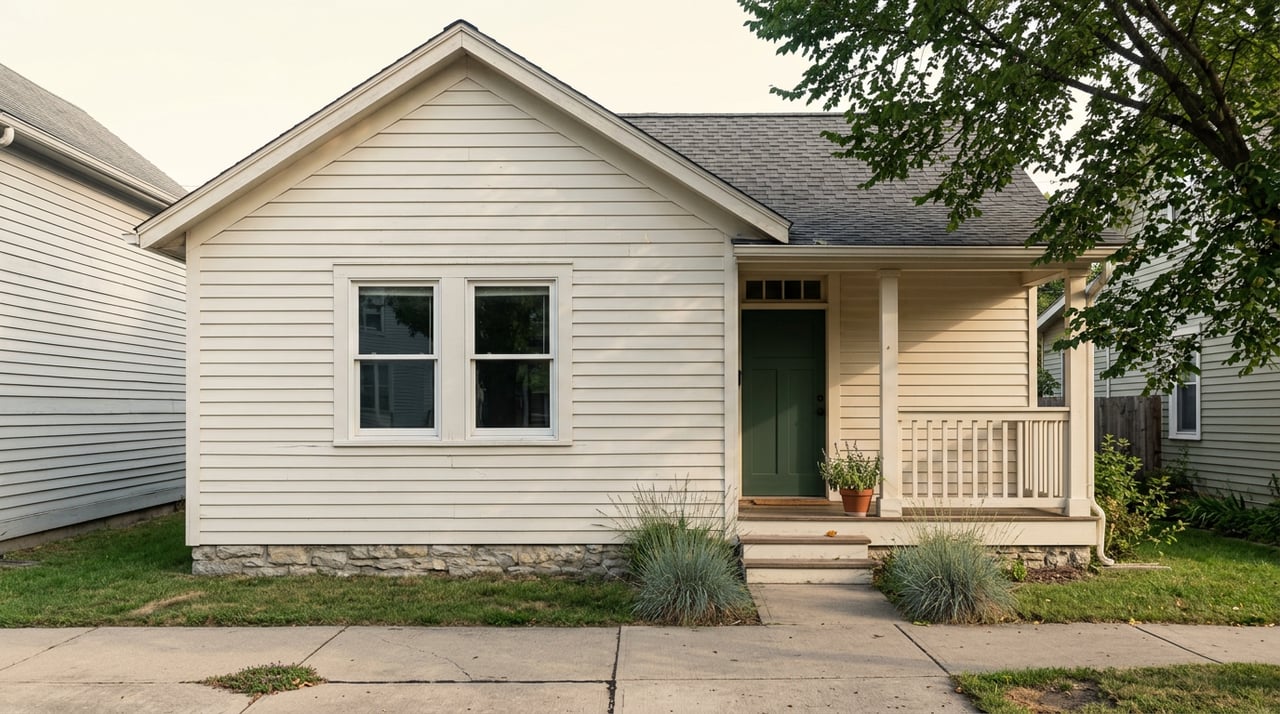
What Gary's 2026 Median Isn't Telling You: Two Price Stacks, One City
July 23, 2026
July 23, 2026
Ask a portal what a Gary home costs and you'll get three different answers before lunch. Zillow's index puts the typical Gary home at $69,155. Redfin's January 2026 snapshot pegged the median sale at $125K. The Northern Indiana MLS rolling three-month read for April through June 2026 comes in at $129,929, up 52.9% year over year. Same city, same quarter, three answers that don't reconcile.
The gap is not a data error. It is the shape of the market. Gary is transacting on two price stacks that run in parallel, and the second stack is the one setting the direction of the first.
| Retail MLS Stack | Shadow Supply Stack | |
|---|---|---|
| Where it lives | Northern Indiana REALTORS MLS | 2026 Lake County Commissioner's Sale, city Side Lot Program, Dollar Home Program |
| Typical entry point | $46K to $200K depending on tier | $25 to a few thousand for parcels, $1 for qualifying Dollar Home applicants |
| Volume | 224 closed sales April to June 2026 | 6,315 parcels at the 2026 Commissioner's Sale alone |
| What the buyer is actually paying for | A house you can finance and move into | A tax certificate, a title path, and a rehab budget |
| Who's active | Owner-occupants, small landlords, some flippers | Cash investors, adjacent owners buying side lots, occupant-applicants meeting the 80% AMI income floor |
The retail stack is what the portals show you. The shadow stack is what the portals cannot show you, because it is not on the MLS and it prices in parcels rather than houses. Both matter for anyone underwriting a Gary purchase in 2026.
A 52.9% year-over-year median move sounds like a boom. It is closer to a mix shift.
Lake County's segmented data for spring 2026 shows the bottom 5% of the market up 17.7% to a median of $46,309, and the starter tier (5th to 35th percentile) up 6.4% to $188,883. Gary transacts overwhelmingly in these two bands. When a handful of higher-tier sales close in a low-volume month, the citywide median lurches. Zillow's ZHVI, which weights the whole distribution and updates monthly, tells a calmer story: Gary's typical home value rose 4.0% over the past year, ending May 2026 at $69,155.
Read that way, Gary is not appreciating at 53%. It is appreciating in the mid-single digits with a lot of statistical noise on top, and the noise is loudest in the tier where most transactions actually happen.
Two things follow for a buyer:
The 2026 Lake County Commissioner's Sale is offering 6,315 parcels this cycle, a large share of them in Gary. Most are vacant lots. A meaningful minority are structures. The city of Gary layers two of its own disposition channels on top:
The Side Lot Program transfers city-held parcels to adjacent owner-occupants at nominal cost, administered by the Gary Redevelopment Commission at 401 Broadway. It is the fastest legitimate path to a wider lot, an off-street parking pad, or a garden expansion for anyone who already owns next door.
The Dollar Home Program, run through the city's Community Development division, sells qualifying tax-foreclosed houses for $1 to applicants who meet an 80% area median income floor (roughly $38,750 based on published guidance), commit to making the home habitable within one year, and remain the owner-occupant for five years before the deed transfers. The city estimates rehab costs at roughly $20,000 to $30,000 per home, which is the honest number to plan around.
None of this inventory appears on the MLS. All of it competes with retail listings for the same buyer pool at the low end.
In late 2025 the state awarded Gary a $15 million READI 2.0 grant, funded through Lilly Endowment Inc. and the Indiana Economic Development Corp. The money began deploying in January 2026 and will run through the end of 2028. It funds three specific downtown anchors, each with a comp implication:
Between READI and the older TOD funding, the demolition pipeline is authorized to clear up to 1,300 blighted properties. Every teardown does two things to a nearby comp: it removes a distressed sale from the tier average, and it converts a negative externality into a buildable lot with a documentable disposition history. Neither shows up in Zillow's model for months.
Behind all of this sits the Northwest Indiana RDA's transit spend: $6 million per year for 25 years to replace the Gary Metro Station, $12 million for downtown demolition, and $650 million to double-track 18 miles of the South Shore Line. The double-track is the piece that shortens the commute to Chicago in a way that a Gary buyer can underwrite.
If any part of the shadow stack is on your list, the timing rules are strict and unforgiving. A few points that catch out-of-state buyers most often:
An Indiana Commissioner's Sale requires the certificate holder to notify interested parties within 90 days of purchase. A Treasurer's Sale allows six months. Miss either window and the lien terminates under IC 6-1.1-25-7(a).
Two more items worth knowing before you bid:
The legal machinery is not the interesting part. The interesting part is that the process forces cash pricing on the low end of the shadow stack, which drags down the reported medians on the retail stack whenever a rehabbed home from the shadow stack finally hits the MLS.
At $40,000 to $70,000. You are almost certainly buying a shadow-stack property. Expect cash, a title path that runs through a redemption window, and a rehab number in the $30,000 to $80,000 range depending on scope. Insurable and financeable is a later problem, not a closing-day problem.
At $90,000 to $150,000. This is the retail sweet spot in 2026. The bottom-5% and starter tiers dominate, and a well-presented three-bed on a stable block near the Miller or Glen Park edges can move inside the roughly 36-day median. Financing is available, appraisals hold in most pockets, and the comp file has enough recent activity to defend a price.
At $175,000 to $250,000. You are underwriting Gary against Hammond, where the June 2026 median ran $199,891, and against the Crown Point starter market at $329,821. The Gary case has to rest on lot size, condition, or proximity to the Metro Station and South Shore Line double-track corridor, because on price-per-square-foot alone the comparison is close.
Is Gary a "hot" market? By supply, yes. Three and a half months of supply in June 2026 is tight by any 2026 benchmark. By price momentum, the honest read is mid-single digits, not fifty percent.
Are the Dollar Home and Side Lot programs worth the paperwork? For an owner-occupant with rehab capacity and time, yes. For a passive investor, no. The occupancy and rehab covenants are enforced.
Does the READI money reach residential streets or just downtown? The current authorized deployment concentrates downtown and around Holy Angels. Adjacent residential blocks benefit from demolition and connectivity work, which is a comp story before it is a construction story.
Should I wait for the new comps? The new-construction comps downtown are a 2027-2028 event on the current schedule. If you find the right block-and-house today, the wait is more expensive than the acquisition.
Gary in 2026 rewards buyers and sellers who read past the median. The retail stack is real, the shadow stack is real, and the demolition pipeline is quietly setting the price floor the portals will only reflect a year from now. If you want the segmented comp analysis for the specific block you're evaluating, or a walkthrough of a Commissioner's Sale parcel before you commit capital, Anthony Kirkland will put the numbers in front of you before the offer goes out. Let's Connect.
Anthony Kirkland offers a steady, market-informed approach to real estate defined by consistency, clear communication, and strong local insight. Serving Chicago, Chicagoland, and Gary, Indiana, he provides focused guidance shaped by each market’s distinct conditions. His approach is strategic and responsive, centered on informed decision-making and strong results.

Anthony Kirkland
10916 S CICERO AVE OAK LAWN, IL 60453